Software
Field Coverage Planner
Coverage paths for any field shape, headlands included
Map your field once, whatever its shape, and the FAOS plans how to cover it row by row, leaving out the areas and obstacles you mark.
One plan for the whole field
Headland and infield passes, one working width apart
A continuous route fitted to your machine and its turning radius
Pass order as usual or optimized for less transit
Headland passes set edge by edge
Obstacles and no-go zones planned around
Convex and concave field boundaries
How it works
-
03
Flexible Pass Order
Work the infield passes in a standard, familiar sequential pattern (A), or let the FAOS optimize the order (B) to reduce overall non-working transit between passes. Shorter turns mean lower operational times and costs.
Two plans of the same field side by side, marked A and B. In A, the tractor works the passes in sequence and loops out into the headland to reach the next one. In B, the order is optimised: it skips passes and turns in one shorter arc to a later one. -
05
Obstacles & Irregular Boundaries
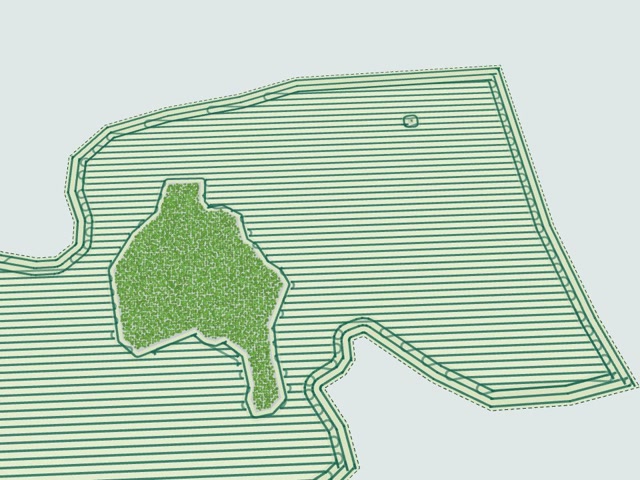
Define the obstacles and no-go zones your machine must avoid. The FAOS adapts the field layout by routing a headland around each obstacle and splitting any intersecting infield passes. Both convex and concave field boundaries are supported.
An irregular field whose edges both bend out and cut in, with a wood in the middle and a small obstacle near one corner, the wood outlined and the small obstacle ringed. As the view sweeps slowly over the field, its plan draws itself on: a headland around each obstacle, passes filling the field around them into every corner, and the turns joining them.